Yesterday, NASCAR announced the latest class to be inducted into the Hall of Fame. Included in this year's inductees are Darrel Waltrip and Cale Yarborough. It's about dadgum time! The younger fans may know Waltrip as the comical fellow from Fox Sports who hollers, "Boogity, Boogity, Boogity" at the start of the race. Before his stint in the booth, though, which fortuitously began at the Daytona 500 in 2001 where Dale Sr. died and DW's little brother won the race, Waltrip was known as the flamboyant driver tied for 3rd on the all time wins list with Bobby Allison. Jeff Gordon's recent win at Pocono now add him to that esteemed group in third.
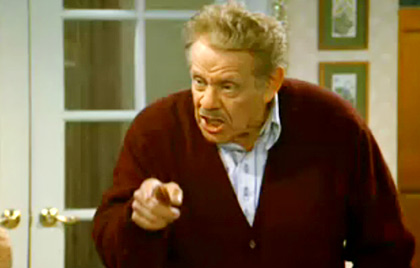
DW gives a celebratory fist pump - Springsteen style!
DW's fellow inductee, Cale Yarborough won three consecutive championships, a feat unmatched in NASCAR history until the new superman, Jimmie Johnson reached number four in his current streak of five and counting. Cale is also the guy who in 1979 got into a little "altercation" with the Allison brothers in the infield at the end of the Daytona 500. It was the first live broadcast of NASCAR, and that little incident has been credited by many as helping fuel part of NASCAR's reputation over the years.
Why it took three years for these boys to make it, Rusty will never know. However, I'm sure glad they did.
In 2006, Warren Moon was elected to the Pro Football Hall of Fame in his first year of eligibility, becoming the first African-American quarterback to be honored in Canton.
I never viewed Moon as anything but a great quarterback, and certainly never looked at him as a "black quarterback." In fact, I wore #12 in my youth league quarterbacking days in honor of my favorite player Randall Cunningham. To me, a great player was a great player. But to Warren Moon, this racial distinction was ever apparent.
With that distinction came many personal, emotional hardships that I or most HHR readers can never fully grasp. And while he comments several times that he never wanted to be remembered as such (a "black" quarterback), he spends most of the 250 pages of his autobiography, Never Give Up on Your Dream, reminding readers that he is a black quarterback.
Literally, nearly every page makes mention of this.
Granted, Moon clearly uses the book as a therapeutic devise to get things off of his chest that he's held in for decades. Unfortunately, some of his arguments about his race contradict other things that he points out in the text.
For instance, Moon notes that despite his high school success, he was never actively recruited as a quarterback by a major D-1 program. In the same breath he notes that his senior year he stood a Flutie-esq 5'11", 165 pounds. Not many big-time recruiters are looking to fill their QB position with someone of that stature.
When finally getting a shot at the University of Washington, he noted that the offense catered to his strengths, moving the pocket, rolling out. He found a fit where the program was willing to change to meet Warren Moon's desires, rather than he himself changing to meet those of the programs he was looking to lead.
Moon rolled the dice, signed with the CFL out of college - a league whose wide-open field and spread offense favored Moon's skill set. While he signed north of the boarder, an NFL team could still have drafted his rights, albeit as a gamble. Moon expresses shock that this didn't happen. Of the fourteen QBs drafted in 1978, Moon noted "It stunned me that I wasn't included in that group somewhere...Although I knew I wasn't going to get drafted, it was still a major shock when my name wasn't called." This statement doesn't even make sense and tells me Moon is either being disengenuous with him memoir or realy has a warped sense of reality - he had just signed a 3-year deal with Edmonton.
Moon notes at the time of the draft the difficulty of being a black quarterback, that most bolt to the CFL and others become wide outs or d-backs. Yet, Doug Williams of HBC Grambling was the first quarterback selected that year.
Truth be told, like Tim Tebow today, it was Moon's ability and skill set that befuddled pro scouts and coaches, as much as his skin color. Neither Tebow nor Moon are/were viewed as "pro-style" quarterbacks.
When Moon finally signed the richest contract in history to land in Houston, the entire offense was adapted to him, incorporating 4 wide receivers and a spread set hardly seen anywhere in the NFL.
The first 200 pages of Never Give Up... are really a recap of Moon's career, with very little revealed. By the time Moon gets around to talking about his missteps - his failed first marriage, domestic abuse accusations, DUIs - they are brushed over in a manner that seems Moon, while saying he accepts responsibility, more paints the incidents as misunderstandings for which he was wrongly characterized.
This isn't to say that the combination of his race and position weren't accompanied by bias or predjudices, but I question Moon's motives, both now and in his playing days. While Moon was always viewed as a person of high character and class, always managing to say the right things as a player, perhaps this was a carefully-calculated approach to not rock the boat and for self-perserverance. With his legacy now secured with a bronze bust in Canton, he is more at liberty to speak his mind on social issues still relevant in the League than he was prior to his enshrinement.
I feel this book was more written for Warren Moon himself, rather than the football fan/reader.
Super Bowl title or no Super Bowl title, Warren Moon was one of the best quarterbacks of his or any era. Few will ever be able to comprehend the added scrutiny that being a black quarterback presents. But Moon doesn't do readers any justice by helping them to understand. Few examples can be viewed as anything other than the author's personal assumption and/or speculation. He could have really pounded home some tangible examples with additional testimony from others in the picture. But rather, Moon internalizes and focuses on #1.
This past weekend, Jim Rice and Rickey Henderson solidified their status among baseball's all-time elite with their induction into the National Hall of Fame. One of those two, Rice, also holds the glorious distinction of being one of 13 lucky living players to be enshrined in both Cooperstown as well as the RBI Baseball Hall of Shame.
Today, we look back at the accomplishments that landed them on this selective list.
Jim Rice
Was suspended for three games by the club for shoving manager Joe Morgan. Rice was angered when Morgan replaced him with pinch hitter Spike Owen in the 8th inning of Boston's eventual win over Minnesota. I'd push my manager too if he took me out for Spike Owen...
Is rumored to have an absolutely massive collection of porno
Is the single-season leader (as well as #2) for most GIDPs
Wade Anthony Boggs
Sued by a flight attendant for threatening and cursing at her. Apparently the shit went down after she refused to serve Wade a final beer before landing. He pointed his finger in her face and threatened to "kick your fat lips in."
Sued for $12 million by former mistress Margo Adams for breach of Oral Contract. They later settled out of court.
Admitted to being a sex addict on National TV
Missed a few games after injuring his back while pulling up his cowboy boots. It was rumored that Margo Adams played a role in the injury and the boots were a cover-up.
Was run over by his wife, like with a car. When authorities arrived Boggs claimed that he fell out of the car and she rolled over him without noticing. Riiiight...
George Brett
Two words - Pine Tar
Broke his toe in 1986 while running from his kitchen to his TV in order to watch the Bill Buckner play.
During the '80 World Series, George Brett had an "attack" of hemorrhoids. He said, at a press conference: "Just because you guys are such perfect assholes, I don't know why you're making such a big deal about this. My problems are all behind me." - Thanks to Justin Pagano for this one
Once, at Royals Stadium, Brett took out his frustration on a trash can. He beat on it with a bat, then threw himself into the trash can. Teammate Jaime Quirk found Brett in the can covered in garbage. *
Gary Carter
Perceived large ego, love of self-promotion and reputation for only playing hard when a game was televised to a national audience earned him the nickname "Camera Carter"
Once, after starting to talk and talk and talk after seeing an LA Times reporter approaching his general area during spring training, teammate Warren Cromartie cried out, "Gary, at least wait until the guy asks a question."
On his 34th birthday, Carter was in the lineup for a game against the Phillies. He went 3 for 3, driving in the Mets' only run with a home run. With 2 out in the 9th, Carter ended the game by getting picked off by Steve Jeltz's hidden ball trick.
Tony Gwynn
Missed a game after breaking the tip of his finger by slamming it in the door of his Porsche on the way to the bank. I would have guessed the bakery...
Reggie Jackson
Is baseball's all-time strikeout leader
Paul Molitor
Dislocated a knuckle when he got it stuck in another player's glove
Cal Ripken
Involved in one of the strangest sports conspiracies of all time. The story goes that Kevin Costner and his wife were staying at Ripkens house in 1997 during a film shoot. Kevin comes home from the shoot and finds Cal in bed with his wife. A melee ensues and Ripken is hurt in the scuffle. Too hurt to play, the Orioles concoct a lighting problem at Camden Yards to postpone that night's game, thus preserving The Streak. Probably bullshit, but the story itself is shameful...
Is the career leader for Grounding into Double Plays
Nolan Ryan
Missed a start after being bitten on the hand by a coyote. And no it wasn't Peter Coyote of The Legend of Billie Jean fame...
Ryne Sandberg
His ex-wife is rumored to have slept with former teammates Rafael Palmerio and Dave Martinez while they were married. That makes for an awkward clubhouse...
Mike Schmidt
Once reported for morning exercises during spring training in 1977 with his pants down at his knees.
Ozzie Smith
Among nonpitchers who started their careers after 1920, only Lloyd "Little Poison" Waner had fewer career homers (27) than Smith (29) and reached the Hall of Fame as a player.
Was fined and suspended in 1988 after starting a brawl by rabbit punching fellow RBIer Will Clark after Clark slid in hard into second base to break up a double play.
Don Sutton
Was ejected from a game and suspended for 10 games for defacing the ball in 1978. After threatening legal action against the National League, Suttons suspension was dropped
You thought we had heard the last of ex-Buffalo Bill and Hall of Fame running back Thurman Thomas? Not so. Courtesy of the folks at Thisiswhyyourefat.com comes this amazing sandwich of the same name. "What does the Thurmanator contain?" you ask.
Two 3/4 pound beef patties under a half a pound of ham, covered in mozzarella, American cheese, lettuce, tomato, mushrooms, sauteed onions, pickles, jalapeno peppers and mayo.
Sounds like you'll be huddling in the bathroom for all four quarters after this one.
Also if you have a free hour, cruise the rest of this website as some of the concoctions are amazing.
Thurman Cafe 183 Thurman Ave (German Village) 614.443.1570 Web site
This past Sunday, prior to the 2009 Hall class announcement, CBS News' Sunday Morning broadcast a piece by Armen Keteyian reenforcing our thoughts on the matter.
HHR has a deep appreciation for the contributions long-time St. Anthony HS coach Bob Hurley has made to the sport of basketball. Hurley has 950-plus wins, 24 state championships, 90 percent winning percentage, has had over 100 former players receive D1 scholarships and had five taken in the NBA draft's first-round NBA.
Today, when one of the most star-studded classes for the Naismith Hall of Fame was announced, Hurley's name was not among those to be enshrined this fall.
I've written before (in regards to Yahoo columnist Adrian Wojnarowski's The Miracle of St. Anthony: A Season with Coach Bob Hurley and Basketball's Most Improbable Dynasty): "It transcends sports and takes a look at the struggles and hardships of a community where little is offered in terms of advancement outside of athletic success...What Bob Hurley does, not just for his team and its players, but for the school itself, is nothing short of, appropriately, a miracle. The man is a saint."
Upon learning of the Hurley Hall omission, The Star Ledger's by Steve Politi takes the argument further (with help from former St. Anthony's standout and NBAer Terry Dehere):
David Robinson was a great NBA player. How many high schools did he single-handedly keep from shutting down? How many teenagers did he help get a college scholarship?
How many lives did he shape?
"Michael Jordan is one person," Terry Dehere, one of Hurley's best players, said by phone Friday. "I don't know if Michael Jordan had a role in getting over 200 kids into college. He never had to be part psychologist, part father, part protector to all those kids for four years.
"Coach Hurley is the type of person in our community that we should put on a pedestal. Hitting jump shots is great, but what we should also value is the quality of a person's character."
Of the 81 coaches currently in the Hall, only two are high school coaches, Morgan Wootten of DeMatha High (Maryland) and Bertha Teague of Byng High (Oklahoma).
Politi thinks he knows why: "The 24-person-selection committee, according to three people familiar with the process who are forbidden to talk about it publicly, is loaded with officials and coaches with ties to the NBA who fail to see that borders of basketball extend beyond the 20,000-seat arenas and million-dollar contracts."
As North Carolina coach Roy Williams put it after his press conference Friday, "Bob Hurley is a Hall of Famer -- period. It's going to happen. It's just a matter of when."
Senator, please show us how much money you've raised so far.
Baseball Hall of Famer and embattled US Senator Jim Bunning admitted in a conference call with Kentucky reporters that his fundraising for his 2010 re-election bid has been "lousy."
From Politico: "Bunning’s remarks aren’t likely to sit well with his party’s leadership, whom the Kentucky senator has repeatedly clashed with in recent weeks. Bunning has accused National Republican Senatorial Committee Chairman John Cornyn of Texas of trying to stunt his fundraising."
Something else that might be stunting his fundraising is that fact that, unlike just about every politician and candidate alive from President to Dog Catcher who has been embracing the Interwebs as a social, communications and fundraising tool, Bunning doesn't even seem to have an active campaign website.
The above article mentioned a fundraiser the Senator will be holding with Dodger mascot Tommy Lasorda. I'd tell you more about the event, but best I can find on his re-election bid is a site created for his 2004 race.
Seizing on the opportunity to capitalize on the media frenzy surrounding "Octo-Mom" Nadya Suleman, embattled and fertile NBA Hall of Famer Calvin Murphy is said to be rapidly altering his physical appearance to look more like Hollywood headcase Angelina Jolie.
The transformation, insiders say, is a move by Murphy, who now insists on being referred to solely as "Catorce-Dad," to thrust himself back into the limelight in an effort to raise money via taxpayers and the Internet to pay off his insurmountable legal and child support bills.
HHR got a hold of this exclusive before-and-after picture, where you can see "Catorce-Dad" actually more resembles Mrs. Pitt than does Suleman.
Hall of Fame pitcher Jim Bunning, most known for his stints with the Phillies and Tigers, caused some fuss this past weekend when the Kentucky Republican commented that Supreme Court Justice Ruth Bader Ginsburg probably isn't gonna win her battle with the big casino.
"Bad cancer. The kind you don't get better from. Even though she was operated on, usually, nine months is the longest that anybody would live."
Coincidentally, RBG returned to the bench today, evoking kind words from Bunning, "I apologize if my comments offended Justice Ginsburg. It is great to see her back at the Supreme Court today and I hope she recovers quickly."
This week, as college standouts showcase their talents before pro scouts at the NFL Combine, players of all skill levels hope to raise their draft stock and secure the lucrative contracts that come with playing in country's premiere sports league. This is a far cry from the practices that accompanied the golden years of professional football, when it was still struggling against baseball, boxing and horse racing for both legitimacy and the public's attention.
One man in that era (along with those associated with his stardom) helped shape the League as we know it today, by transforming both the college and pro game and its perception with the public.
Harold "Red" Grange is considered the greatest college football player who ever lived. While "Western" football was looked at as far inferior to the Ivys of the East, the Illinois standout legitimized the sport as one that appealed beyond the silver-spooned campuses of Yale, Penn and Princeton and paved the way for programs in the Midwest to showcase some of the country's best talent.
Known for his effortless gait, the Galloping Ghost's legacy is one that has rarely been looked at in depth, despite his unprecedented contributions to the game. At a time when most college players, especially superstars, capitalized on their stardom by forgoing the stigmatic notion of turning pro in favor of a white collar desk job, Grange's decision to sign with the Chicago Bears turned the college football community on its head. With Grange bringing tens of thousands of fans to pro stadiums across the country, he created a frenzied rush by other teams to emulate the Bears' model of signing and showcasing a major entertainment attraction.
Grange wasn't alone. His chief confidant-turned-agent, a noted con man named C.C. Pyle, saw the potential that the floundering NFL had, and flaunted it to his and his client's financial benefit (as well as that of NFL owners...when Grange was in town, at least).
It came a cost. Literally fresh off his college season, Pyle booked the Ghost and his Bears on a grueling nationwide barnstorming tour that often had the team playing 2-3 games a week.
While his health, and subsequently performance, suffered, Grange was still a box office hit, as fans clamored to witness the rumored legend that was so eloquently painted by respected sports writers of the day.
We recently caught up with the author to discuss his book.
HuggingHaroldReynolds: Red Grange is widely considered the greatest college football player ever and is often credited with legitimizing the professional game. Yet, until your latest biography on him, few major accounts of his life have been published. Why are football's golden years and its players often overlooked, and what made you decide to fill the void and pen a piece on the Galloping Ghost?
Gary Andrew Poole: Football hasn't always been a super-popular subject. Of course, there have been some excellent books written about football, but the publishing industry considered it a second-tier category in the sports genre. Baseball, golf and even boxing have traditionally dominated the sports bookshelf. (There is a cottage industry in Babe Ruth biographies.) But football has become our national game so there is more interest in it from publishers, authors, and readers. I have noticed that more quality football titles have been written over the last couple years. You can look at last fall in which a whole bunch of football books were released, including Jeff Pearlman's Boys Will Be Boys and Michael Rosenberg's War As They Knew It. Many of the books have been about more recent history. I thought there was a real gap in books about the early history of the game. I was shocked that no major publisher had tackled the Grange story. Not only did I think there was a great narrative to tell, I thought Grange--the Babe Ruth of football--was an overlooked figure. Many people consider Grange the most important figure in football, both college and pro; ESPN named him the greatest ever college football player; he was America's first national football hero and thanks to his charismatic and conniving manager, he was America's first sports commodity as well. I just thought there needed to be a major biography of this guy.
You also asked about why football of this era gets overlooked. Baseball, boxing, and just about every other major sport, haven't drastically changed over the years, but football looks much different. Baseball--minus the steroids era--is pretty much the same game that was played in the 1920s. But football was a radically different game in the 1920s. At its highest levels it was an exciting game, but it was more of an endurance sport (players often played the whole game, offense and defense); passing was a smaller element because the ball was wider and more difficult to throw; and kicking played into strategy much more (it wasn't unusual to punt on first down to backup your opponent). I wanted to give people a context to appreciate it, and to understand how football has evolved. It is virtually impossible to compare statistics and there isn't much film footage, even of Grange, the greatest player of that era. Through my book's narrative, I try and give modern readers a sense of the game, and the drama playing on and off the field.
HHR: Illinois coach Bob Zuppke essentially rolled the dice in terms of recruiting given his aversion to many of the practices and because of his own personal philosophies, and almost missed out in landing Grange. Had Grange not gone to his home-state university, would history have been different and what is that chance that the football world would have missed out on one of its greatest talents?
GAP: That's a hell of a tough question. Along with Michigan's Fielding Yost and Notre Dame's Knute Rockne, Bob Zuppke was one of that era's greatest coaches. He was very creative and invented the "flea flicker," among other plays. He was also more than willing to pass the ball, which was looked upon as pretty crazy back in that era. Grange really thrived under Zuppke, and in turn Zup's reputation was forever tied to Grange's success, but Zup couldn't lower himself to beg a 17-year-old kid to play football for Illinois. He would have been embarrassed to act like Lane Kiffen, Charlie Weiss, Urban Meyer, Pete Carroll or other modern coaches as they glad-hand a high school kid...If Zup could have watched modern recruiting practices he would puke. Zuppke saw football as a way to learn discipline and leadership, and he believed that playing football at a university was an honor; football was a maker of men, not an end to itself. After his last college game, Grange decided to turn pro, which was shocking to Zuppke and the rest of the college football establishment. Zuppke, a surrogate father to Grange, was upset and didn't really talk with his greatest pupil for a couple years.
Would history be different without the Zuppke-Grange partnership? Zup would devise his whole game plan around Grange, and he was also very good at motivating the Galloping Ghost. So I don't know. If Grange would have gone to Michigan or Notre Dame, he might have had more consistently good players around him, but he would have been in much more plodding offenses...Zuppke and Grange formed a perfect storm: Zuppke's creativity as a coach, and Grange's creativity as a runner. But no matter where Grange played, I am guessing he would have excelled. In several of his greatest games, he almost single-handedly won the contests. Grange would have a terrible team around him and he was still able to dominate and even astonish some of the best teams in the country. Those games, in which Grange had to overcome great adversity, created his legend.
HHR: C.C. Pyle is painted throughout the book as a con-man. While the physical ramifications of Grange's career have undoubtedly been negatively affected by their association, has Grange's reputation and legacy at all been tarnished by Pyle's involvement?
GAP: Maybe Pyle hurt Grange's reputation, for a time, back in the 1920s, but Pyle was his own force of nature and I think the public came to realize that Grange had benefited from the relationship in many ways. I think the public simply saw Grange as naïve.
HHR: Despite his unsavory ways, Pyle in many ways can be credited as being one of the innovators who helped shape both the game as we know it today, as well as the role agents have taken in modern sports. Can you elaborate?
GAP: Many people see Pyle as a conman and I go to great lengths to narrate his rather dubious dealings, but I also see Pyle as a creative force, and an overlooked figure in sports history. He was Grange’s Col. Parker (i.e. Elvis’ manager). It was Pyle's plan to make Grange into a pro, which was outlandish in the 1920s because pro football was a joke. Pyle also realized that marketing the pro game and creating stars resonated with the public. Pyle was an entertainer, an old vaudeville guy who had many connections in Hollywood. He understood the power of movies, sports imagery, and the press, and he had the smarts to create schemes for Grange, many of which vaulted Grange from great college football player to cultural icon. Without Pyle, Grange might have been remembered as a great college player, but nothing more. For better or worse, he paved the way for Drew Rosenhaus and his ilk.
Photo: Pro Football HoF Grange signing pro contract with Bears co-owners Edward Sternaman and George Halas (left) and Grange's manager C.C. Pyle (right).
HHR: A handful of East Coast sports writers played a large role in legitimizing the pro game by bringing it to the masses. Luckily, in their eyes, Red lived up to expectations. Had Grange not performed the way he had in the Illinois-Penn game, how different a course would the sport have taken?
GAP: Let me give the HHR readers a little context. Back in 1925, Illinois went to Philly to play the University of Pennsylvania. Penn was considered a national championship contender (the national title nonsense was as big a clusterf*!k back in the '20s as it is today). Except for Red Grange, Illinois was not a very good team. Penn was expecting to rout the Illini. All of the big time New York writers came to Philly to watch the contest. They were half-expecting to see Grange fall on his face, but he single-handedly took over the game and ran for 363 yards and three touchdowns. They were astonished. He already had a national reputation but playing on the East Coast and dominating a great team made him into the equivalent of Babe Ruth, and in fact many of the writers were saying he was more popular than Ruth. The florid writing and the newsreels featuring Grange made him into a demi-god.
Then Grange decided to turn pro. This move was greeted with great skepticism by the press, but fans loved the idea. In the 1920s, many people worked on Saturdays and it wasn't always easy to get tickets to college games—the tickets were expensive, and many people were living in cities so getting to a place like South Bend, Indiana wasn't always so easy. Grange took the game to people and they gobbled it up. He went on a nation-wide barnstorming tour and he sold out games in Chicago, New York, Boston, D.C., Tampa, New Orleans, Los Angeles...everywhere. The football wasn't always so great because Grange and his teammates were playing several games a week but Grange's tour helped legitimize the game. The media was tracking Grange across the country, and after the tour he starred in a movie and endorsed many products, and then tried to break the NFL by starting his own league. He was quite powerful and popular. He became exceedingly rich through pro football in a time in which most players were making $200 a game. Pro football would have eventually become more popular, I am guessing, but Grange really jumpstarted the pro game and created legitimacy, not only with fans but players. He made it ok for a college player to join the pros. George Halas said what television is to the modern era, Grange was to the earlier era.
Just to give readers a little more context, the great sportswriter W.C. Heinz wrote a profile of Grange in 1958, and I think it personifies an older generation’s awe of The Galloping Ghost.
“When I was ten years old I paid ten cents to see Red Grange run with a football. That was the year when, one afternoon a week, after school was out for the day, they used to show us movies in the auditorium, and we would all troop up there clutching our dimes, nickels or pennies in our fists.
“The movies were, I suppose, carefully selected for their educational value…but I remember only the one about Grange.
“I remember, in fact, only one shot. Grange, the football cradled in one arm, started down the field toward us. As we sat there in the dim, flickering light of the movie projector, he grew larger and larger. I can still see the rows and rows of us, with our thin little necks and bony heads, all looking up at the screen and Grange, enormous now, rushing right at us, and I shall never forget it. That was thirty-three years ago.”
HHR: As a journalist, what is your impression of (and perhaps appreciation for) the poetic nature journalists in the 20's portrayed athletes in the absence of 24/7 televised coverage, and ultimately in helping modern historians to piece together facts? Is the notion that many of them protected athletes by glossing over unsavory facts hurt their credibility, especially as we witness the opposite extreme today? Were they preserving or forging facts/reality?
GAP: I actually wrote an essay about this same subject in the Columbia Journalism Review (January/February issue); the article-- Back to the Future: How sports writing can recapture its relevance-- delves into the history of sport writing, the impact of the Web and blogs, and how modern sports writing could be better.
But to directly answer your question: Some of the story leads went over-the-top but when you get into the guts of many of the game stories, there is an enormous amount of reporting and wonderfully rendered detail. Did they protect athletes? To some degree. But I wouldn't simply categorize it as glossing over unsavory facts; I don't think the sports writers were blindly protecting athletes. Remember, a lot of these sports writers had been in World War I, child mortality rates were higher, life was harsher...Sports were seen as games, as a relief from the struggles of life. There was a maturity and perspective on sports. We live in a different era, and sports and athletes are taken more seriously. Did 1920s writers gloss over too much? Perhaps, or maybe they had a more realistic view of human nature and a more mature perspective. As our society has become more educated and softer and athletes have become richer and treated as outsiders, we have taken a harsher, more adversarial, and cynical view of athletics.
But I don't think the writers ignored everything. Grange allegedly had a kid out of wedlock and the writers wrote about it; they talked about his pathetic vaudeville act when he was gong broke; when he was playing terribly and a member of his entourage started a riot in the stands, the press talked about it. I spent three years reading newspaper articles of the early era of sports writing. There is a stereotype that sports writers were protecting everyone and I just don't think that rings true. Some of the writers were pretty damn harsh. Like in any era, there is good writing and bad writing/good reporting and bad reporting, but in the earlier era there was a maturity level; a sense of human nature, its glories and foibles. Sports is an important subject and it deserves dogged reporting. But in modern journalism an athlete will be caught doing some nefarious act and the foaming-at-the-mouth tone demonstrated by the press often seems ridiculous, false, hypocritical, and rather immature to me.
By the way in the researching and writing of my book I didn't rely simply on newspaper accounts. I decided to take a modern approach to my subject and dig deeper than my 1920s compatriots. It was an exhaustive effort. To give events more perspective, I dug up courts records, police reports, oral histories, etc. from the 1920s. I didn't want to write a love letter to Grange and the era; I wanted to write a real story. For example, I spent a year finding Grange's "illegitimate" daughter. So I used newspaper accounts in my book, but I always tried to double-check the journalists of the day with primary sources, as well.
HHR: With the uncertainty of professional football in the 20's, Grange's dive into the pros was a calculated gamble to capitalize on both his popularity and physical ability. Had he and Pyle not taken the path they chose, between the barnstorming and the ramped up publicity machine, how long would it have taken the NFL's founding fathers, most of whom were football purists despite the knocks on the pro game, to realize the commercial appeal and marketability of the stars?
GAP: Pre-Grange, the NFL was doing ok: a few thousand people would come to the games. Grange joined the NFL and Pyle promoted him like crazy. People came in droves to watch Grange and he sold out stadiums all over the country. The next season the NFL owners were promoting individual stars. But I think they would have figured it out eventually.
HHR: Throughout the book, Grange is put on the same Mount Rushmore of sports with Babe Ruth, Jack Dempsey and Bobby Jones. For the benefit of our young readers, is there any modern day athlete whose impact and ability can be most likened to Red?
GAP: In his glory days, he was the kind of guy people had to see. He brought drama to the game. He seemed to always perform in the clutch. He was a Tiger Woods- like figure.
HHR: Your website is brilliant and vibrant. Tell us a little about your podcast, some of your other projects and what's next for GAP.
GAP: Thanks. We worked hard on it, and I really hope people check it out, particularly the Experience section of the site. As for my podcast, it mostly has interviews with me on my book tour, but I am hoping to put more on it--interviews and essays--in the near future. I also have a blog. It is called In The Fray and I typically highlight great sports writing, post commentary, and write some other observations. For the last several months it has become a chronicle of my book tour, but I am phasing out the navel-gazing and getting back to its original mission. As for other projects, I am working on some articles, and I am also working on a new book proposal, which is another sports book but set in modern times.
Earlier this month, I wrote about NFL Hall of Famer and former Michigan Wolverine captain Benny Friedman and his struggle for recognition as one of football's early pioneers and as the game's first true innovator of the forward pass.
I was fortunate to be able to catch up with Greenberg to help elaborate on some of these unanswered questions.
HuggingHaroldReynolds: You cite the 1998 Brandeis tribute to Benny Friedman as sparking your interest in writing this book. Prior to that, how familiar with the quarterback were you? Was it as a football/sports fan that you felt it was time this story was told or did you feel that culturally it was long-overdue?
Murray Greenberg: As an intercollegiate athlete at Brandeis years after Friedman had left there, I had heard of him, but really knew no details of his life and career until that 1998 tribute. Friedman was a genuine American innovator and American Jewish hero, a major celebrity who had fallen through the cracks over time, so his story was long overdue on several levels.
HHR: The book makes a very strong case regarding Benny's role in pioneering the modern game - not just his influence in establishing the pass as a common element of the offense, but to the point where defenses were forced to account for it and as a result new defensive formations were created, namely the advent of the modern linebacker position.
MG: When the great Sammy Baugh passed away last month, many in the media widely hailed him as the man who transformed football as the game's first great passer. With all due respect to the immortal Baugh, the man who transformed football as the game's first great passer was Benny Friedman. In 1929 Friedman, playing for the New York Giants and throwing the roundish "melon" ball then in use, passed for an unheard-of 20 touchdowns (breaking his own record). Hall of Famer Ernie Nevers was second that year with six TD passes. Friedman's record lasted thirteen years, finally falling to Cecil Isbell in 1942. Benny's pioneering passing inspired the league to slim down the ball and eliminate rules that discouraged passing, paving the way for such passers as Isbell, Arnie Herber, Sid Luckman, and Baugh (who still didn't pass for as many as 20 touchdowns in a season until his seventh year in the league)."Friedman revolutionized football," George Halas said. And yet he is overlooked, as illustrated in the wake of Baugh's death.
There may not be any one reason for this. Though I did not encounter hard evidence that would establish anti-Semitism as an explanation for Friedman having been overlooked, anti-Semitism can be subtle. Given that, and given Friedman's extraordinary accomplishments in and singular contributions to the game of football, it is not unreasonable to consider anti-Semitism as a possible factor. His perceived cockiness when it came to his football skills, his lobbying for induction into the Pro Football Hall of Fame, his bitterness at the Players Union for denying pension benefits to pre-1958 players, and the mere passage of time since his playing days are also possible factors. And sometimes, for no apparent reason, people who have made significant contributions in their field, even those who attain celebrity at some point, become lost over time.
HHR: Benny can be in many ways pointed at as the first Jewish sports hero. Yet, his popularity transcended just the Jewish community. His religion is an underlying theme throughout the book, especially given the rise in anti-Semitic attitudes during his height of popularity. Yet, it was a large part of his marketability, and didn't seem to directly negatively impact him in many ways (though it can be argued there was a good amount of latent bias). How much was being Jewish help Benny compared to hinder him?
MG: Rising anti-Semitism in America in Friedman's time was a factor to be dealt with by every Jewish athlete of the day, and Friedman was the most famous and best Jewish footballer of all. Mistreatment from Friedman's first Michigan coach -- mistreatment that Benny attributed to anti-Semitism -- nearly suffocated Friedman's playing career before it got started. On the other hand, Friedman was a hero to the American Jewish community, a fact that played a part in the two college head coaching jobs Friedman would get -- both at schools with heavy Jewish influence. But Benny's Jewishness was also a fact that may have played a part in the several major college coaching jobs he sought but didn't get.
HHR: Football at the time was rather one dimensional, as were the mindsets of the coaches and players regarding how the game "should be played." How much a factor would you attribute the novelty of the forward pass upon unsuspecting defenses/teams compared with Benny's talent as a reason for his success? Was the style of play as much a "secret weapon" as much as Benny was? Was it the fact that Yost was forward-thinking enough to utilize the athlete's talents?
MG: Before Friedman, defenses generally were not prepared to defend the pass, but that is because no passer as talented as Friedman had ever appeared. As no less an authority than Red Grange said, "Benny Friedman was responsible for changing the entire concept of defense." Yost certainly was aware of the talent his quarterback had and was smart enough not to let football's anti-passing traditions stop him from letting Friedman use that talent. Friedman's unique passing ability may have been a secret at first, but teams quickly realized what they could expect and began drawing up defenses just to stop him -- usually without success.
HHR: How big an influence was the outcome of the Notre Dame/NY Giants game on the perception of pro football?
MG: While the 1920s saw college football experience perhaps its most glorious era, that decade saw the National Football League in a struggle for survival. Professional players were widely viewed as rough, relatively unskilled mercenaries lacking in spirit and discipline. Neither the fans nor the media were willing to divert their passion for the glamorous college game to the hardscrabble pro league. Even the NFL's flagship franchises -- the Packers, the Bears, the Giants -- struggled mightily at the gate. The Notre Dame/Giants game in 1930, which I detail in the book and in which Friedman played a major role, provided a critical boost for the NFL's credibility.
HHR: In many ways, Benny resembles an early Joe Namath. Both were given "astronomical" contracts for the not only their transformational styles of play, but for the fanfare and gate receipts that accompanied it, their self confidence, their similar collegiate paths and leadership reputations while playing for legendary coaches, and, of course, their use of the forward pass and the way they/it ushered in two very transformational eras of the pro game - Benny's to the modernization, Namath's to the AFL-NFL merger/Super Bowl/television era. Is there a better modern player with whom to compare Benny?
MG: As you point out, there are some interesting parallels between Namath and Friedman (though Benny, a big believer that players could play tough while protecting themselves from injury,believed that Namath did not properly protect himself). Peyton Manning and Tom Brady at first blush might not appear too similar to Friedman given the disparity in size between them and Benny, but when it comes to the qualities that make for a great quarterback -- outstanding passing ability, field generalship, leadership, and physical toughness -- there is a good deal of similarity.
HHR: The decision to cut the football program at Brandeis was described as hastened by both a sense of jealousy over Benny's popularity and subsequent fund raising ability, as well as the disdain by academics at the university who sought to disassociate itself with the "brutish" sport with the school's blooming scholastic reputation. That said, what is the current perception at Brandeis of Benny's contributions and reputation as a part of its establishment and success?
MG: I believe there is some awareness and appreciation within the athletic department and within the university administration at Brandeis of Friedman's indispensable contributions to Brandeis athletics and to the university generally. I hope my book will help to broaden and deepen that awareness and appreciation.
HHR: Given his contributions to Michigan in the 1920's, and the fact that college football was drawing tens of thousands of spectators weekly in college stadiums across the country, pro football aside, how hasn't his college success and recognition alone propelled Benny's legacy?
MG: I would reiterate my response to question 2.
HHR: While a handful of early stars are synonymous with the sport - Grange, Nagurski, Rockne, and most recently with his death, Sammy Baugh's multifaceted on-field exploits are remembered again heralded, in general, do you feel the post-1960's modernization and commercialization of pro football has come about at the expense of the history of the sport?
MG: I think there is a tendency for the history of a sport to become somewhat forgotten as time marches on and the sport evolves and takes hold of its current generations. Modern-day sports are an important part of America's social fabric. The way the games are played today and the players of today should be appreciated and celebrated. But it is important also to celebrate and appreciate the pioneers who laid the foundation for the sporting spectacles we now enjoy-- pioneers such as Bobby Orr, whose rink-long rushes popularized hockey's "offensive defensmen"; Babe Ruth, whose astonishing home runs revolutionized baseball; and Benny Friedman, football's first great passer, whose unique ability to pass the football launched the game toward its passing-dominated modern era and its status as an American sporting obsession.
Not for anything, but this looks like a hella good time.
Hall of Famers Ryne Sandberg and Frank Robinson joined the President for the Tee Ball on the South Lawn All-Star Game yesterday.
Kenny Chesney joined in on the festivities and sang "Take Me Out to the Ballgame" after unveiling a new stamp commemorating the centennial of the song.
White House photos by Eric Draper and Chris Greenberg.
Our buddy Yanni shot out an email yesterday with an interesting article on John Feinstein's new book "Living on the Black: Two Pitchers, Two Teams, One Season to Remember," on Moose and Glavine's 2007 season.
What ensued was the email recipients launching into a debate on Mussina's Hall credentials as prompted by Portly Jay's comment: "I'm going to read through this email more thoroughly, but for the time being, all I've read is the part about Mussina being a Hall of Famer. As I've said from the beginning of this argument for Mussina, you've gotta draw the line somewhere. Otherwise, Tommy Greene is on-deck, right Ren?"
Let's take a look at some of the chatter. Bear in mind that this was before Moose got shellacked and knocked out in the first inning by the O's last night. POrtly Jay almost seems a soothsayer.
Yanni:
Lets face it - he lacks those intangibles. Never won 20. Never threw a no-hitter. Never won a Cy Young Award. Never won a World Series.
If i had to build a narrative for moose's induction - I would have to stress the period in which he pitched (steriods, hgh, the lowering of the mound, the trend toward smaller parks - all of which greatly benefit the hitter).
The problem we run into there though is that his peers Clemens, Maddox, Glavine, Johnson, all have those intangibles mentioned earlier.
The other big problem here, is that there are guys ahead of him ( i.e. Blylevin, Tommy John, and Jim Kaat) in the 285-295 win range and are not in the Hall.
Moose is 39 years old. He has 256 wins. Our best bet is to just hope he can continue on in the mold of a Jaime Moyer or a Kenny Rogers or even a David Wells and pitch until his mid-40s. If he can grow as a finesse pitcher and continue changing speeds and relying on good location and getting good run support - who knows, maybe he can go on another 3 or 4 years and reach 300. Stranger things have happened.
If he ever gets there or not, he is my favorite player. He is one of the few good guys left in the game. When he is on, watching him pitch is like watching a fine artist paint the corners. its all about changing speeds and location. I cant wait to watch him go tonight against the Orioles.
Dino:
Wow! All of a sudden the steroid era didn't help the pitchers out! That's a crazy, absurd argument!!! The lowering of the mound does actually hurt pitchers, as much as anything. That's the reason why it's a disadvantage to face a 6'10"" guy like Randy Johnson. All the new ballparks as well that were favorable to hitters. He won 19 in a strike season of 1994. Hence, he would have won his 20 games. He played for a bad team for several years. Tom Glavine played for the best team in baseball for those same years...the argument's not Glavine vs. Mussina, but i'm just saying as a standalone pitcher, the guy deserves it in this modern era of baseball. Stupid relievers like Dennis Eckersley (a starter half his career) and Rich Gossage get in while better players such as Mike Mussina don't? That's ridiculous...very much like the Rock'N'Roll Hall of Fame!!!!
Portly Jay:
I'll be thinking of those inspiring words after I see Adam Jones hit a ball through the ozone layer and Moose just stands there with his hands on his hips in a pouting fashion. I'm not a fan. However, I like The New Steinbrenner. Baby Boss gave such an inspirational speech to the NY Post that even the skeleton of General Sherman had to blush.
Yanni:
I would also add that the advent of the 5-man rotation and the increasing importance of bullpens as additional factors making 300 wins more difficult.
Dino:
I think with 250 wins in modern day baseball in the steroid era, he should get in. If you talk about the top 10 pitchers of the last 20 years, it would actually be very hard to argue that he doesn't belong in that list. These days, we're seeing an older, less dominant pitcher. But in his prime, he was a top notch starter. There will probably never be another 300 game winner. I think 250 is the barrier we should look at these days. Fat Willard:
Here is a good marker, game 7 World Series, who would you rather hand the ball to? I say Mussina. If you add 'big game' ability, Mussina wins out. Game 7 Yankees vs. Sox, shut them down for 3+ innings, a starter out of the pen, led to the Boone homerun. Like Dino said, Mussina won on average O's teams while Glavine was the 2 sometimes 3 best pitcher on championship teams. And look at Glavine last season. Mets needed ONE win, their 'ace' on the mound, gave up like 6 runs in 2 innings check the box score on that one. But it wasn't pretty
Green Bay Packers Coach Vince Lombardi, Yankee Yogi Berra and Former Knick/US Senator Bill Bradley were among 15 first-ever inductees into the New Jersey Hall of Fame this past Sunday.
Joining them were Frank Sinatra, astronaut Buzz Aldrin, Gen. Norman Schwarzkopf, Nobel Prize winner Toni Morrison, Albert Einstein, Thomas Edison, American Red Cross founder Clara Barton, publisher Malcolm Forbes, and Gen. Robert Wood Johnson II, "familiar to many through the philanthropic foundation that bears his name, was represented by his grandson, New York Jets owner Woody Johnson."
The final inductee was a former amateur pitcher with very unorthodox form. Bruce Springsteen was honored despite his inability to put away Craig Nettles. His friend, a big baseball player back in high school, failed to make the cut, and is said to be very bitter. The two are no longer on speaking terms despite recently seeing one another at a local bar, sitting down and having a few drinks.
Last night I caught pieces of the interview Fat "Uuuuhh" Mike and Chris had with Cris Carter on WFAN. He continues to prove himself one of the most competent and knowledgeable former pros who now makes a living both in front of the camera and online.
As an Eagles fan, I never begrudged Carter for the success he went on to achieve with the Vikings. When he admitted the reason for his release from the Birds had more to do with his substance issues rather than Buddy Ryan's claim that all he did was "catch touchdowns," part of me was relieved he was finally able to recognize and overcome his demons.
I speak from personal experience.
When I was younger, my youth football league's banquets would often feature local teams' players. Notably, the late Andre Waters had made appearances several years in a row, often bringing younger teammates with him. One year, that younger teammate was a blinged-out Cris Carter sporting a nice full length fur (maybe chinchilla).
As kids lined up for autographs, shortly into the night it became apparent that Carter was in no condition to be around kids, and was asked to leave.
Now fast forward some 20-some years.
On Saturday, Carter deserves to join the ranks of the immortal in the Pro Football Hall of Fame, as do fellow wide receivers Art Monk and Andre Reed.
Carter not only went on to clean up his act and put up Hall-worthy numbers, but has proven himself as an ambassador of the game and a humanitarian with knowledge, contributions, and most admirably, his humility.
On Sunday, Fat Willard reported that "Major League Baseball could face a class-action lawsuit from former minor leaguers who believe they were denied a fair shot at making the majors because of steroids in the game."
If I were any of the above players, I would think I had a legitimate argument for a similar lawsuit for being denied a fair shot at immortality.
As Clemens noted taking "painkillers" for his achy "joints," his career prolonged as Murphy and the Hawk's knees and Donnie Baseball's back withered them into retirements.
But many of us who covered the National League in the '80s still can't figure out why. Dawson, Mike Schmidt and Dale Murphy were the megastars in that league back then.
On Hawk:
Dawson was such a force, he won one MVP award and finished second twice. He was also a rookie of the year. He won eight Gold Gloves. And he spent a bunch of years in the who's-the-best-player-in-baseball debate.
On back-to-back MVP Murphy:
And the forgotten stars of the '80s keep on coming. No player of his generation has been more outspoken about the steroids era than Murphy. And, sadly, it's possible that no great player has had more damage done to his candidacy by that era -- and its inflated numbers -- than Murphy, either.
His 398 homers and that .469 career slugging percentage look downright ordinary nowadays. But remember, this is supposed to be about what these men did in their era.
Even without his 80's mustachio, Stark makes sense.
Maybe I'm biased for these guys. That was the era in which I grew to love baseball. To me Blyleven and Rice made their bones in the 70's (Yes, I know Bert spanned 3 decades).
While Raines not getting in on this ballot is a minor tragedy, he will certainly get his, hopefully sooner rather than later. However, as the perpetual holdovers continue to take up ballot space and new classes emerge, he could be stuck in the same purgatory for some time.
2009 features no-brainer (pun intended) Rickey Henderson along with borderliners David Cone and Mark Grace, while 2010 will certainly raise debate with first-timers Roberto Alomar, Andres Galarraga, Barry Larkin, Edgar Martinez and Fred McGriff. As only Goose made it in today, things could get crowded.
While often highlighted, I don't feel Rule 5 in the Hall voting criteria is legitimately taken seriously: Voting shall be based upon the player's record, playing ability, integrity, sportsmanship, character, and contributions to the team(s) on which the player played.
If Murphy's record, playing ability, integrity, sportsmanship, character, and contributions to the team(s) on which he played couldn't bolster his legitimacy among voters, where's this leave a guy like Martinez in 2 years? At least Edgar played on some decent teams.
Don't discount geography either. This certainly hindered Rock Raines, and while Edgar was the heart and soul of Pacific Northwest baseball (along with Jay "How the hell could you trade" Buhner), it'll likely hinder him as much as his DH-distinction. Mind you, Murphy played on the only team in the Southeastern US prior to Florida expansion, albeit while being broadcast on the Superstation.
I'm not saying that the system is flawed or even the voters. BBWAA should in fact be a very strong determining factor in the process, but not the end-all, be-all. Well, maybe I am. If you're pissed now, by the constant snubbing, brace yourself for the immediate future.
Says Stark, "I keep waiting for the backlash against the steroids era to start working in the favor of players like Rice. It hasn't happened yet. But backlash or no backlash, we're supposed to be comparing players to other players in their time, not anybody else's time."
PRNewswire: "For the first time in nearly ten years, Jockey International, Inc., the iconic American apparel brand, has returned to the airwaves with the launch of a new television ad that is part brand promotion and part social commentary."
If by "social commentary" they mean making it acceptable for 70's sports icons to display their manly fur in skimpy psychedelic briefs and bikinis, more power to them.
Tim Pitt, Jockey's Vice President of Global Advertising and Marketing: "This ad captures the essence of Jockey's authenticity, and takes a stand against society's often-unrealistic expectations of what the "ideal" person should be. What we're saying is that in a world where you can be anything, the most wonderful thing you can be is yourself."
You might have noticed in ESPN's Hall of Fame 2008 section where writers "debate" the merits of borderline MLB Hall of Famers such as Mark McGuire, Goose Gossage, Bert Blylevin and HHR favorite Tim "Rock" Raines.
Mr. Baseball Peter Gammons took the liberty of going back and forth with Jason Stark (sans mustachio) on the topic of Raines.
Each year when Hall of Fame voting rolls around, there is as much debate over the power of Baseball Writers Association of America as there is over the players on the ballot themselves. Truth be told, these writers hold in their hands the ability to control individuals' immortality, an immortality most of these writers will never know. And worse than that, they know it, and they exploit it; they flaunt it. They alone know who is and who isn't worthy of enshrinement.
Whether its Lupica, or to an extent Bob Ryan, these guys hold themselves in such high regard as the end-all, be-all of sports knowledge. None, so pompous, however, as Gammons. Yet for some odd reason, the public seems to revere him and his smug look and attitude.
Oh and he is better than you. As are all the old-school baseball and sports writers who made their bones in mail and copy rooms while you were still dating cheerleaders.
Continue to worship them if you must, as that is what they insist you do. Gammons especially. He is a god. He controls destiny. He can be as big an ass to kids as he wants, know one will blink an eye. Immortals can do that. You are just a lowly man, even if you made him what he is, ego and all.

 DW gives a celebratory fist pump - Springsteen style!


 by
by